Thermal cures
Terme di Roma provides thermal cures with the sulphurous water of the Acque Albule springs, accredited with the Italian National Health Service. The areas treated are respiratory, osteoarticular, dermatological, ENT and gastroenteric.
Balneotherapy
Balneotherapy is the immersion of the body in temperature-controlled sulphurous thermal water: at Terme di Roma it uses the water of the Acque Albule springs and is indicated for dermatological conditions (psoriasis, eczema, atopic dermatitis) and osteoarticular disorders.
NHS-accreditedHydropinic therapy
Hydropinic therapy is the controlled oral intake of thermal water, in doses and schedules prescribed by a physician: it is indicated for dyspepsia of gastroenteric and biliary origin and for irritable bowel syndrome with constipation.
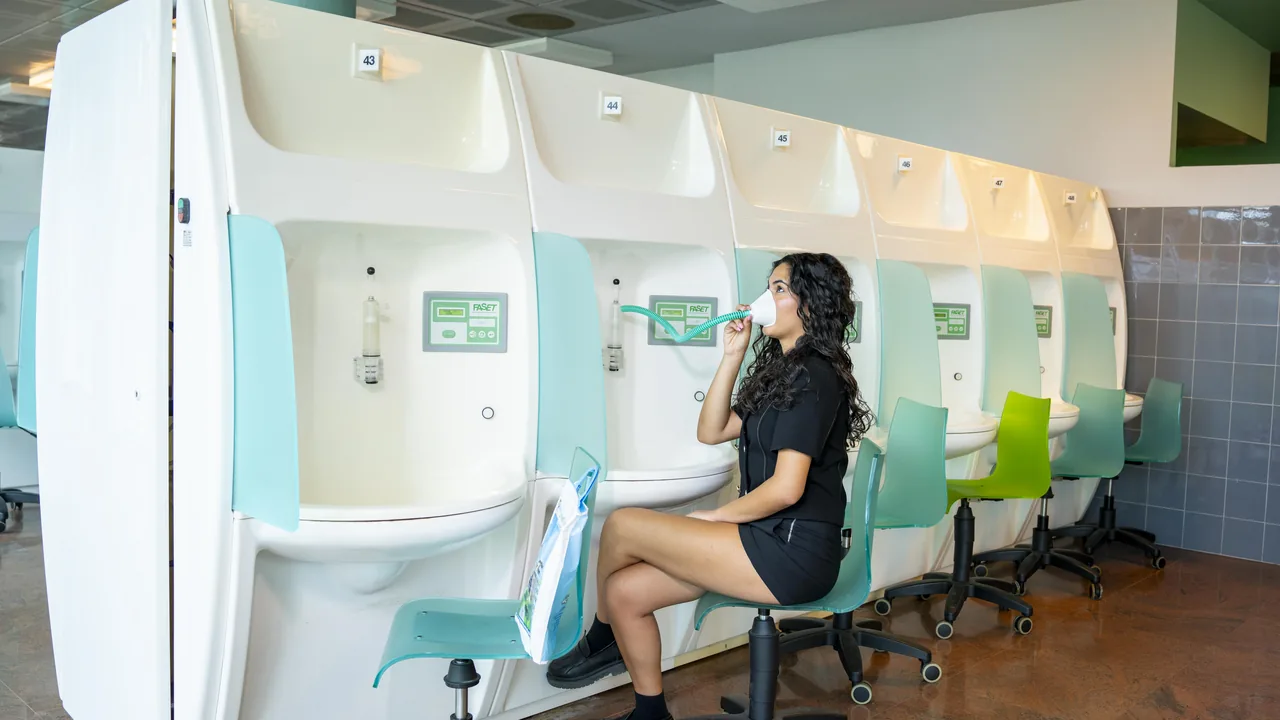
NHS-accreditedInhalation therapies
The inhalation therapies at Terme di Roma treat chronic respiratory conditions with the sulphurous water of the Acque Albule springs, delivered as aerosol and warm-humid inhalations.
NHS-accreditedMud-bath therapy
Mud-bath therapy combines the application of hot thermal mud (40-42°C) with a subsequent bath in sulphurous water: it is the reference thermal treatment for osteoarthritis, extra-articular rheumatism and chronic musculotendinous pain.
NHS-accreditedRhinogenic hearing loss (endotympanic insufflations)
Endotympanic insufflations treat rhinogenic hearing loss and Eustachian tube dysfunction by introducing low-pressure sulphurous thermal gas into the tubal area, promoting middle-ear ventilation and drainage.
NHS-accreditedThe waters and the treatments
The thermal cures of Terme di Roma are based on the use of the Acque Albule, sulphurous, hypothermal waters historically linked to the area of Tivoli Terme and used in therapeutic, preventive and rehabilitation programmes. The establishment offers treatments aimed in particular at the respiratory, osteoarticular, dermatological, ear-nose-throat and gastroenteric areas, available privately or, in the cases provided for, under agreement with the Italian National Health Service (SSN).
The waters used at the centre come from the springs of the Regina and Colonnelle lakes and are characterised by the presence of sulphur and of compounds that give the water its recognisable, typically opalescent appearance. Their properties are put to use in treatments such as inhalation therapies, balneotherapy, mud and balneotherapy, therapy for rhinogenous deafness and hydropinic therapy (drinking cure), according to medical indication and depending on the type of disorder.
Thermal cures do not replace other healthcare treatments, but can play a supporting role within a broader clinical pathway. For this reason, access to treatments covered by the SSN requires a medical prescription and a health assessment within the establishment, while private programmes may be aimed both at wellbeing and at functional support where there are specific needs.
Treatable conditions and access under SSN agreement
| Conditions | Treatment | SSN agreement | Cure details |
|---|---|---|---|
| Osteoarthritis and other degenerative conditions Extra-articular rheumatism |
Balneotherapy, mud and balneotherapy | Yes | Balneotherapy Mud and balneotherapy |
| Chronic rhinosinusitis-bronchial syndromes Chronic bronchitis Vasomotor rhinopathy Chronic pharyngolaryngitis Chronic sinusitis |
Inhalation therapies | Yes | Inhalation therapies |
| Eustachian tube stenosis Chronic catarrhal otitis Chronic purulent non-cholesteatomatous otitis |
Endotympanic insufflations (rhinogenous deafness) | Yes | Rhinogenous deafness |
| Psoriasis Eczema Atopic dermatitis Seborrhoeic dermatitis Acne |
Balneotherapy | Yes | Balneotherapy Thermal dermatology |
| Dyspepsia of gastroenteric and biliary origin Irritable bowel syndrome, constipation-predominant variant |
Hydropinic therapy | Yes | Hydropinic therapy |
| Chronic obstructive pulmonary disease (COPD) | Integrated pulmonary ventilation cycle | Yes — temporarily suspended | Inhalation therapies |
| Urinary tract stones and their recurrence | Hydropinic therapy | Yes — temporarily suspended | Hydropinic therapy |
All conditions treatable under SSN agreement
The 130 diagnostic categories for which Terme di Roma provides thermal cures under agreement with the SSN, with the treatment cycle provided for each. They are those conditions, from the list under the Ministerial Decree of 15 December 1994 referred to in Annex 9 to the Prime Ministerial Decree of 12 January 2017 on the Essential Levels of Care, for which the establishment provides the corresponding cycle. The integrated pulmonary ventilation cycle, vaginal irrigations and hydropinic therapy for urinary tract stones are temporarily suspended: the corresponding conditions remain recognised under the agreement and are marked as suspended.
Show the full list of conditions
Inhalation therapies 35 conditions
24 treatments in 12 sessions
- Chronic adenoiditis
- Chronic bronchitis, simple or obstructive
- Chorditis (all types)
- Chronic pharyngitis
- Pharyngo/laryngitis
- Chronic pharyngo/tonsillitis
- Adeno/tonsillar hypertrophy
- Chronic laryngitis
- Pansinusitis
- Polyp/sinusitis
- Polypous sinusitis
- Allergic rhinitis
- Catarrhal rhinitis
- Chronic rhinitis
- Chronic atrophic rhinitis
- Simple chronic catarrhal rhinitis
- Chronic purulent rhinitis
- Hyperergic rhinitis
- Hypertrophic rhinitis
- Perennial rhinitis
- Secretory rhinitis
- Vasomotor rhinitis
- Rhinoethmoiditis
- Rhinopharyngitis with adenoid involvement
- Rhinosinusitis
- Chronic rhinosinusitis syndrome
- Chronic rhino-bronchial syndromes
- Rhino/sinus/bronchial syndromes
- Chronic rhino/sinus/bronchial syndromes
- Chronic rhinosinusitis-bronchial syndromes; vasomotor rhinopathy; chronic pharyngolaryngitis and sinusitis
- Chronic sinus-bronchial syndromes
- Allergic sinusitis
- Recurrent chronic sinusitis
- Hyperplastic sinusitis
- Recurrent tonsillitis
Integrated pulmonary ventilation cycle 18 conditions
12 pulmonary ventilations and 18 inhalation therapies in 12 sessions
Service temporarily suspended. The conditions listed here remain among those recognised under the SSN agreement; for information on when the service will resume: 0774 408500.
- COPD
- Bronchiectasis
- Asthmatiform or spastic bronchitis
- Chronic bronchitis with obstructive component
- Chronic asthmatiform bronchitis
- Chronic catarrhal bronchitis
- Chronic emphysematous bronchitis
- Simple chronic bronchitis or with obstructive component; COPD (excluding asthma and advanced emphysema complicated by severe respiratory failure or chronic cor pulmonale)
- Chronic hypersecretory bronchitis
- Asthmatiform or spastic bronchopathy
- Chronic bronchopathy
- Obstructive bronchopathy
- Chronic bronchopathies from occupational exposure to irritants and dusts
- Chronic bronchopneumopathy
- Chronic asthmatiform or spastic bronchopneumopathy
- Chronic obstructive pulmonary disease (COPD)
- Non-specific chronic bronchopneumopathies without signs of severe respiratory failure and not in an acute exacerbation
- Chronic tracheobronchitis
Cycle for rhinogenous deafness 19 conditions
12 endotympanic insufflations and 12 inhalation therapies in 12 sessions
- Eustachian tube catarrh
- Eustachian tube dysfunction
- Hearing loss
- Rhinogenous hearing loss
- Otitis associated with nasal conditions
- Chronic catarrhal otitis
- Secretory otitis media
- Purulent otitis
- Chronic purulent non-cholesteatomatous otitis
- Sero/mucous otitis
- Serous otitis
- Oto/salpingitis
- Oto/tubaritis
- Otopathy
- Mixed hearing loss
- Rhinogenous deafness
- Tubal stenosis; chronic catarrhal otitis
- Tubaritis
- Tubotympanitis
Mud therapy with or without baths 25 conditions
12 mud applications with or without 12 baths or showers in 12 sessions
- Rheumatoid arthritis in the quiescent phase
- Osteoarthritis (with diffuse or localised osteoporosis)
- Osteoarthritis of the limbs
- Diffuse osteoarthritis
- Neck pain of rheumatic origin
- Cervical osteoarthritis
- Disc disease without herniation and without symptoms of nerve irritation or compression
- After-effects of surgery for herniated disc
- After-effects of articular rheumatism
- Fibromyositis
- Fibrosis of rheumatic origin
- Fibrositis
- Low back pain of rheumatic origin
- Lumbar osteoarthritis
- Osteoarthrosis (with diffuse or localised osteoporosis)
- Osteoarthritis and other degenerative conditions
- Osteoarthritis and other degenerative conditions (12 mud applications and 12 baths)
- Periarthritis
- Scapulohumeral periarthritis (excluding acute forms)
- Polyarthrosis (with osteoporosis, diffuse or localised)
- Inflammatory rheumatism (in the quiescent phase)
- Ankylosing spondylitis
- Spondyloarthrosis
- Spondyloarthrosis and spondylolisthesis
- Tendinitis of rheumatic origin
Therapeutic bath for osteoarthritic conditions 2 conditions
12 baths in 12 sessions
- Osteoarthritis and other degenerative conditions
- Extra-articular rheumatism
Balneotherapy 8 conditions
12 baths in 12 sessions
- Recurrent acne
- Seborrhoeic dermatitis
- Recurrent seborrhoeic dermatitis
- Allergic dermatitis (excluding acute vesicular and exudative forms)
- Constitutional eczema
- Contact eczema
- Eczema and atopic dermatitis (excluding acute vesicular and exudative forms)
- Psoriasis (excluding pustular and erythrodermic forms)
Hydropinic therapies 3 conditions
12 hydropinic treatments
- Urinary tract stones and their recurrence (temporarily suspended)
- Dyspepsia of gastroenteric and biliary origin
- Irritable bowel syndrome, constipation-predominant variant
Cycle for peripheral vascular conditions 1 condition
12 therapeutic baths in a communal pool with hydromassage
- After-effects of chronic venous disease
Vaginal irrigations with bath 19 conditions
12 vaginal irrigations and 12 baths in 12 sessions
Service temporarily suspended. The conditions listed here remain among those recognised under the SSN agreement; for information on when the service will resume: 0774 408500.
- Recurrent miscarriage
- Adnexitis of the genital tract
- Non-specific cervicovaginitis
- Dystrophic cervicovaginitis
- Endometritis
- After-effects of genital surgery (vaginal or abdominal)
- Uterine fibromyomatosis
- Pelvic inflammation
- Hysterectomy
- Persistent leucorrhoea due to chronic non-specific or dystrophic vaginitis
- Metritis
- Oophoritis
- After-effects of vaginal surgery
- Salpingitis
- Painful sclerosis of the pelvic connective tissue
- Secondary infertility due to pelvic inflammatory disease
- Secondary infertility following surgery
- Secondary infertility following pelvic inflammatory disease
- Vaginitis
How to access cures covered by the SSN
The SSN covers one cycle of treatments per year, equal to twelve days of treatment; some categories of invalids are entitled to a second cycle (see “Co-payment exemptions”). The cure is prescribed by your GP (family doctor) or, for children, by the paediatrician, on the red SSN prescription form.
Two rules worth knowing before you book:
- the cycle must be completed within sixty days of the start date of the cure;
- the prescription is valid for the calendar year, from 1 January to 31 December: the cure cannot be split into separate periods of the same year.
Before you start
- Go to the Admissions desk of the establishment with the RED prescription form (ricetta rossa) from your GP (family doctor), which must state the condition, the diagnosis and the cure to be carried out, in accordance with the summary scheme of Ministerial Decree 15/12/1994.
- Pay the co-payment (ticket) of € 55,00. Exempt patients pay € 3,10 on presenting the prescription form bearing the exemption code issued by their local health authority (ASL), compatible with thermal cures.
- Collect the radio-frequency badge issued at the Admissions desk: it must be kept and used every day to activate the treatments and record the cures received, and it must be returned at the end of the cycle.
- Attend the medical examination at the establishment’s clinic, to check that there are no contraindications to the therapy prescribed by your GP. The examination is compulsory and involves no additional cost.
During the cycle
After the medical examination a personal treatment record is issued, required for mud and balneotherapy and balneotherapy cures, to be shown every day to the staff administering the treatments.
At the end
The identification badge must be returned. Anyone who needs it for work purposes may request a certificate of the cycle of treatments completed.
Co-payment exemptions
The Italian National Health Service (SSN) covers one cycle of thermal cures per year. Patients without an exemption pay a co-payment (ticket) of € 55,00 per cycle (the amount in force since 1 January 2016). The exemption code must be written by the doctor on the red prescription form.
Pay only € 3,10 per cycle
- Children under 6 and people over 65, with a family income of up to € 36.151,98 (code E01).
- Unemployed people and their dependants, with a family income of up to € 8.263,31, rising to € 11.362,05 with a spouse, plus € 516,46 for each dependent child (E02).
- Holders of a social pension and their dependants (E03).
- Holders of a minimum pension aged over 60 and their dependants, with the same income limits (E04).
- Civil invalids from 67% to 99%; work invalids from 67% to 79%; service invalids of categories 2 to 5; war invalids of categories 6 to 8; blind people; deaf-mute people; minors receiving the attendance allowance.
Pay nothing
- War invalids of categories 1 to 5 with a direct life pension.
- Seriously disabled service invalids (category 1).
- Civil invalids at 100%, with or without the attendance allowance.
- Seriously disabled work invalids (from 80% to 100%).
A second cycle in the same year
War and service invalids, blind people, deaf people and civil invalids (including those with an invalidity between 34% and 66%) may have a second cycle in the same year, to treat the condition that caused the invalidity. The second cycle is also paid according to one’s own exemption.
For categories not listed: telephone 0774 408500 · info@termediroma.org
Thermal cures covered by INPS for workers
For workers registered with INPS (the Italian National Social Security Institute), absence from work to undergo thermal cures is treated as sick leave. INPS grants cures to prevent, delay or remove a state of disability, after checking insurance, contribution and health requirements, and only for osteoarticular conditions and conditions of the lower respiratory tract. For dermatological (except psoriasis with joint involvement), gynaecological, ear-nose-throat, urological, vascular and gastroenteric conditions, cures are available only through the National Health Service (SSN).
How to apply
The application is submitted to the INPS office of the place of residence by 31 December of each year. The application form already includes the certificate on which the worker’s doctor states the condition for which the cures are requested.
Who pays for what
The cost of the cures is borne by the National Health Service; board and lodging in affiliated facilities are paid by INPS; the co-payment (ticket) and travel expenses are paid by the patient.
Employees, public employees, armed forces
Outside ordinary leave and annual holidays, public and private employees may undergo cures only for genuine therapeutic or rehabilitation needs related to an ongoing condition, on a reasoned prescription by an ASL specialist, or if referred to the cures by INPS or INAIL on a reasoned prescription by those institutes. Public employees may use sick leave in the cases provided for by law, when the prescribing doctor certifies that the treatment cannot be postponed. Armed forces and police personnel are entitled to fifteen days’ leave for thermal cures, under the conditions set by the regulations.
For your own position: your local INPS office. For the cures: telephone 0774 408500 · info@termediroma.org
INAIL agreement
Terme di Roma has an agreement with INAIL (the Italian National Institute for Insurance against Accidents at Work) and welcomes insured persons authorised to undergo cycles of thermal and rehabilitation treatments.
Recognised cycles
- all cycles of thermal cures already covered by the SSN;
- treatment cycle for neuromotor rehabilitation;
- treatment cycle for the rehabilitation of patients with motor impairments;
- treatment cycle for respiratory rehabilitation.
Who is entitled
Workers who have suffered an accident at work or an occupational disease, during the period of total temporary incapacity, with a reasoned clinical opinion and the consent of the competent local health authority (ASL); recipients of compensation for an accident at work or occupational disease whose impairments fall within the conditions of the Ministerial Decree of 15 December 1994; recipients of compensation or an annuity for silicosis or asbestosis with the same impairments.
What is required
The original red prescription form is required, stating the cure approved by INAIL and the related diagnosis. The application is submitted to the patient’s local INAIL office, at the request of the treating doctor, together with a medical certificate attesting the impairments and the type of cure considered necessary: the Institute’s medical officer examines the application and identifies the most appropriate cure.
Duration and ancillary benefits
The number of sessions is set by the INAIL doctor. The thermal treatment authorised by the Institute lasts fifteen days per year (twelve of treatment plus three for travel). INAIL reimburses travel expenses and accommodation in an approved hotel, including for an authorised companion where applicable.
For the whole duration of the authorised cycle, INAIL patients may stay at the Victoria Terme Hotel ★★★★, inside the Thermal Park of Terme di Roma: the treatment departments are reached on foot from the room, with no need to travel.
Source: INAIL circular of 15 May 2023, ref. no. 118 — Protocol on ancillary financial benefits for hydro-mud-thermal cures and climatic stays.
Information and bookings: telephone 0774 408500 · info@termediroma.org
Services provided under accreditation
Decree of the Commissioner ad Acta no. U00003 of 9 January 2015.
- Mud therapy with therapeutic bath
- Mud therapy with cleansing bath
- Inhalation therapy
- Therapy for rhinogenous deafness
- Gynaecological irrigations (service temporarily suspended)
Physiotherapy centre
- Individual and group motor re-education
- Hydrotherapy
- Spinal mobilisation
- Localised massage therapy
- Reflexotherapy
- Postural exercises
- Pain-relief electrotherapies · Muscular electrotherapy
- Contact diathermy · Ultrasound therapy · Laser therapy
Authorisations to provide the cures
- Authorisation of the Municipality of Tivoli no. 61942 of 15/12/2006 — thermal centre.
- Authorisation of the Municipality of Tivoli no. 45568 of 12/09/2016 — physiotherapy centre.
Medical Directorate
The Medical Director of the thermal establishment is Dr Mara D’Andrea, registered with the Rome Medical Association (Ordine dei Medici di Roma) under no. 45192, specialised in Medical Hydrology at the University of Rome “La Sapienza”.
The scientific basis of the cures
Thermal cures are healthcare services recognised by the SSN for the conditions listed above. What this recognition rests on, and how far the evidence goes, is a legitimate question: the answer is below, with sources.
What the literature says
Rheumatic diseases. The available systematic reviews report an effect on pain, joint function, medication use and quality of life in osteoarthritis. The most recent and methodologically rigorous meta-analysis (Aribi et al., BMJ Open 2025, GRADE method) confirms the effect but rates the certainty of the evidence as low. International guidelines do not give balneotherapy a strong recommendation: it should be regarded as a complementary treatment, not a substitute for therapy and exercise.
Respiratory tract. Meta-analyses on inhalation therapies describe consistent effects on mucociliary clearance and on the symptoms of chronic rhinitis and rhinosinusitis. For chronic obstructive pulmonary disease, the only robust randomised study (Contoli et al., 2013) showed a reduction in oxidative stress and an improvement in symptoms with sulphurous water. Here too: adjuvant therapy, never a substitute for respiratory rehabilitation, vaccinations and drug therapy.
Skin. For mild and moderate psoriasis, systematic reviews report a real but modest benefit. In eczema and atopic dermatitis, balneotherapy should be regarded as a support, not an alternative to dermatological therapy.
Digestive system. The literature attributes to sulphurous waters an action on intestinal motility and on the biliary tract, although the studies are dated and of limited quality.
What we do not claim
The literature attributes antioxidant, immunomodulatory and cytoprotective effects to sulphur and hydrogen sulphide. These are descriptions of biological mechanisms, documented in laboratory studies and animal models. Every course of treatment is to be assessed with a doctor, and the indications remain those recognised by decree.
Sources
- Aribi I, Nourredine M, Sanchez E, et al. Efficacy and safety of balneotherapy in rheumatology: a systematic review and meta-analysis. BMJ Open. 2025;15(2):e089597.
- Antonelli M, Donelli D, Fioravanti A. The efficacy of balneotherapy, mud therapy and spa therapy in patients with osteoarthritis: an overview of reviews. International Journal of Biometeorology. 2021;65.
- Maccarone MC, Magro G, Solimene U, et al. Balneotherapy for osteoarthritis: a systematic review. Rheumatology International. 2023;43(9).
- Cao CF, Ma KL, Li QL, et al. Balneotherapy for fibromyalgia syndrome: a systematic review and meta-analysis. Journal of Clinical Medicine. 2021;10(7):1493.
- Moini Jazani A, Nasimi Doost Azgomi H, Nasimi Doost Azgomi A, et al. Efficacy of hydrotherapy, spa therapy and balneotherapy for psoriasis and atopic dermatitis: a systematic review. International Journal of Dermatology. 2023.
- Contoli M, Gnesini G, Forini G, et al. Reducing agents decrease the oxidative burst and improve clinical outcomes in COPD patients: a randomised controlled trial on the effects of sulphurous thermal water inhalation. BioMed Research International. 2013;2013:927835.
- Costantino M, Conti V, Corbi G, et al. Sulphate mineral waters: a medical resource in several disorders. Journal of Traditional and Complementary Medicine. 2020;10(4).
- Maraver F, Carbajo JM. Sulphurous mineral waters: new applications for health. Evidence-Based Complementary and Alternative Medicine. 2017;2017:8034084.
Bibliography selected by the Scientific Committee of Terme di Roma, updated June 2026.
Regulatory references
The conditions for which thermal cures are recognised are those in the list under the Ministerial Decree of 15 December 1994, referred to in Annex 9 to the Prime Ministerial Decree of 12 January 2017 which defines the Essential Levels of Care.
Tariffs and procedures for the provision of thermal services under SSN agreement are governed by the National Agreement for the provision of thermal services 2025-2028, implementing the same Prime Ministerial Decree. For 2026 the maximum reimbursement tariffs remain confirmed.
Frequently asked questions
Which thermal cures are available at Terme di Roma?
Inhalation therapies, balneotherapy, mud-bath therapy, endotympanic insufflations for rhinogenic hearing loss and hydropinic therapy, all based on the sulphurous water of the Acque Albule springs.
Are the cures accredited with the Italian National Health Service?
Yes. Where applicable, one cycle of cures a year can be taken under the national health service, with a prescription from the family doctor and the reception procedure of the centre.
Which water is used in the treatments?
The Acque Albule: sulphurous, hypothermal waters from the Regina and Colonnelle spring lakes in Tivoli Terme.
How far is Terme di Roma from Rome?
The centre is in Tivoli Terme, Via Tiburtina Valeria km 22,700, about twenty minutes from Rome. The nearest railway station is Tivoli Terme.